

The Nigerian education landscape is undergoing a remarkable transformation. School proprietors in Lagos, Abuja, and Port Harcourt are discovering that the right school management platform isn’t just about digitizing records—it’s about fundamentally improving how schools operate, communicate, and deliver education. But with so many options available, what should Nigerian school administrators actually look for when making this critical decision?
This comprehensive guide breaks down the essential features, critical considerations, and strategic factors that separate excellent school management platforms from mediocre ones. Whether you’re modernizing a small private school or upgrading systems at a large secondary institution, understanding what to look for ensures you make an investment that delivers value for years to come.
Why Choosing the Right School Management Platform Matters More Than Ever
Before diving into specific features, it’s essential to understand why getting this decision right is so critical in 2025. Nigerian schools face unprecedented pressure to modernize operations while maintaining affordability. Parents have become more discerning, expecting transparency, convenience, and modern communication channels. Why digital school management systems are critical in 2025 goes beyond simple convenience—it’s about competitive survival.
Schools with the wrong platform experience frustrated teachers wasting time on clunky interfaces, parents unable to access basic information about their children, administrators drowning in system limitations, and ultimately, a poor return on their technology investment. Conversely, schools with the right platform see dramatically improved efficiency, enhanced parent satisfaction, better fee collection rates, and more time for educators to focus on actual education rather than paperwork.
Understanding school management systems from a beginner’s perspective helps clarify what these platforms do and why careful selection matters so much.
Essential Feature #1: Comprehensive Academic Management
The core purpose of any school management software is managing academic operations effectively. But not all academic management features are created equal.
Student Information System
Your platform must maintain complete, easily accessible student profiles. This includes enrollment details with admission dates, class assignments, and student ID numbers. Guardian information should be comprehensive with multiple contact options, relationship details, and emergency contacts. Medical records and health information must be securely stored and easily retrievable when needed. Academic history tracking should follow students throughout their time at your school, creating cumulative records that inform instruction.
The best systems make accessing this information intuitive. Teachers should be able to pull up complete student profiles in seconds. Administrators need filtering and searching capabilities that help them find students based on various criteria quickly.
Grade and Result Management
Modern school management systems must handle Nigeria’s specific grading requirements. The platform should support continuous assessment tracking across multiple tests and assignments throughout the term. Customizable grading scales should accommodate different subjects, levels, and school policies. Automated calculations must eliminate manual computation errors that plague manual systems.
Report card generation should align with Nigerian formats and standards. Parents expect professional-looking reports that clearly communicate their children’s academic standing. The system should generate these reports automatically once grades are entered, saving teachers countless hours of manual preparation.
Result processing for external examinations requires special attention. Schools preparing students for WAEC, NECO, and GCE need systems that facilitate mock exams, practice tests, and result tracking aligned with these examination formats.
Timetable and Schedule Management
Creating and managing timetables manually is notoriously time-consuming and error-prone. Your chosen school management platform should streamline this process dramatically.
Digital timetable creation tools should allow administrators to build class schedules efficiently, automatically flagging conflicts like teachers assigned to multiple classes simultaneously or classrooms double-booked. Once created, timetables should be instantly accessible to all stakeholders—teachers view their teaching schedules, students see their class timetables, and parents can check their children’s daily routines.
Exam timetables require similar functionality with added features for invigilation assignments, room allocations, and schedule distribution. The system should make exam week coordination smooth rather than chaotic.
Assignment and Homework Tracking
Teachers need efficient tools for creating, distributing, and grading assignments. The platform should allow teachers to post assignments with clear instructions, due dates, and point values. Students should receive notifications about new assignments and approaching deadlines.
Submission tracking shows teachers who has submitted work and who hasn’t at a glance. Grading tools with rubrics and comment fields streamline assessment. Auto-calculation of assignment grades into overall course grades eliminates manual gradebook maintenance.
Parents benefit from visibility into assignment completion rates, helping them support their children’s learning at home without constant emails to teachers.
Essential Feature #2: Robust Administrative Tools
Administrative efficiency directly impacts your school’s bottom line and operational effectiveness. Look for platforms that excel in these critical areas:
Digital Attendance Management
Manual attendance recording wastes valuable instructional time and creates opportunities for errors and disputes. Digital attendance tracking transforms this daily task from burden to benefit.
Your platform should allow teachers to record attendance in seconds using mobile devices, tablets, or computers. Multiple marking options (present, absent, late, excused) provide nuanced tracking. Real-time processing means attendance data is immediately available to administrators and parents.
Automated parent notifications for absences improve accountability. The system should send SMS or app notifications when students are marked absent, allowing parents to verify legitimate absences or identify truancy immediately.
Pattern analysis helps identify chronic absenteeism early. The platform should flag students with concerning attendance trends, enabling early intervention before academic performance suffers.
Teacher attendance tracking with similar features ensures complete visibility into staff presence and punctuality.
Fee Management and Payment Processing
For most Nigerian schools, improved fee collection alone justifies the investment in a school management system. Boosting fee collection through management systems delivers measurable financial returns.
Essential Fee Management Capabilities:
Your platform must support flexible fee structures accommodating tuition, extracurricular fees, transportation charges, exam fees, and miscellaneous charges. Different fee structures for different grade levels or programs should be easily configurable.
Automated billing generates fee invoices at the start of each term based on student enrollment and applicable fee structures. This eliminates manual invoice preparation and ensures consistency.
Payment gateway integration with Nigerian processors is absolutely critical. The platform must integrate seamlessly with Paystack, Flutterwave, Interswitch, and other popular payment gateways. Parents should be able to pay fees online 24/7 using cards, bank transfers, or USSD codes.
Payment tracking provides real-time visibility into who has paid, who owes balances, and overall collection rates. Automated payment reminders via SMS and email improve collection rates significantly—many schools report 20-30% improvements in on-time payments.
Fee-related reporting should provide administrators with clear insights into revenue, outstanding balances, payment trends, and financial forecasting data.
HR, Payroll, and Staff Management
As schools grow, managing staff manually becomes increasingly burdensome. Your platform should streamline personnel management comprehensively.
Employee record management includes complete staff profiles with contact information, qualifications, employment history, and contract details. Document management stores employment contracts, certificates, and performance reviews securely.
Leave management allows teachers to request leave through the system, managers to approve or deny requests digitally, and administrators to track leave balances and patterns. Payroll processing capabilities should handle salary calculations, deductions, allowances, and payslip generation automatically. Integration with accounting software ensures financial reconciliation.
These features free administrators from time-consuming manual HR tasks and reduce errors in compensation and record-keeping.
Admissions and Enrollment Management
First impressions matter. Your admissions process sets expectations for parent experience throughout enrollment.
Online application forms on your school website collect prospective student information efficiently. The system should store applications centrally, track applicant progress through your admissions pipeline, schedule and manage entrance exams, and facilitate enrollment processing once students are accepted.
This digitization makes admissions more professional, reduces manual paperwork, and improves conversion rates from applicants to enrolled students.
Essential Feature #3: Communication and Engagement Tools
Effective communication between schools, parents, teachers, and students distinguishes excellent schools from mediocre ones. Your school management platform should facilitate seamless communication across all stakeholder groups.
Parent Portal
Parents demand transparency and convenient access to information about their children. Why parents prefer digital school management systems centers largely on the parent portal experience.
Must-Have Portal Features:
The portal must provide instant access to current grades and academic performance trends. Parents should see assignment grades, test scores, and overall term performance without contacting the school.
Attendance records should be available in real-time, showing daily presence, tardiness patterns, and absence reasons. Fee information including current balances, payment history, and upcoming charges must be clearly displayed with convenient payment options.
School announcements and event calendars keep parents informed about important dates, school activities, and urgent communications. Direct messaging with teachers allows parents to ask questions or express concerns conveniently without scheduling formal meetings for routine matters.
The portal should display the child’s timetable, upcoming assignments, and exam schedules, giving parents visibility into their child’s academic commitments.
Mobile Applications
Nigeria’s high smartphone penetration makes mobile accessibility essential. Your platform must offer excellent mobile apps for both iOS and Android.
Mobile App Essentials:
Parents need all portal functionality available in intuitive mobile apps. Push notifications for important updates—new grades posted, fees due, absence alerts, school announcements—keep parents engaged and informed.
Teachers benefit from mobile apps that allow attendance recording on phones or tablets, grade entry from anywhere, reading and responding to parent messages, and accessing student information during parent conferences or while moving between classrooms.
Students at secondary level should access their timetables, view grades and assignments, receive homework reminders, and access learning resources through mobile apps.
App performance matters significantly. Slow, buggy apps frustrate users and reduce engagement. Look for platforms with highly-rated mobile apps and responsive performance.
Automated Notifications
Strategic automated communications improve engagement dramatically while reducing administrative burden.
The system should automatically send absence notifications to parents when students are marked absent, fee reminders as payment deadlines approach, exam schedule reminders before major tests, assignment due date reminders to students and parents, and urgent announcements requiring immediate attention.
Multiple delivery channels—SMS, email, and app push notifications—ensure messages reach recipients through their preferred communication methods.
Direct Messaging
Secure messaging between teachers and parents eliminates phone tag and enables convenient asynchronous communication.
Teachers should be able to send messages to individual parents or groups, share updates about student progress or concerns, and respond to parent inquiries at their convenience. Parents can ask questions, request meetings, and stay informed about their children without interrupting the school day with phone calls.
Message threading, read receipts, and archiving help both parties manage communications effectively.
Essential Feature #4: Learning and Assessment Tools
Beyond administrative functions, your school management platform should enhance actual teaching and learning.
E-Learning and Content Management
Blended learning combines traditional instruction with digital resources. Your platform should support content delivery effectively.
Teachers need tools to upload lecture notes, presentations, and study guides. Video integration should allow embedding or linking to instructional videos. Assignment and quiz creation tools enable digital assessment creation. Resource libraries organize materials by subject, topic, and grade level.
Students benefit from 24/7 access to learning materials, allowing them to review concepts, complete assignments, and prepare for exams outside classroom hours. The academic advantage of school management platforms includes this extended access to educational resources.
CBT Exam Platform
Computer-based testing is increasingly important in Nigerian education. Your platform should include robust CBT functionality.
Essential CBT Features:
Mock exams modeled after WAEC, NECO, and GCE formats familiarize students with external examination structures. Past question integration allows students to practice with actual previous examination questions, improving preparation effectiveness.
Timed testing simulates real exam conditions, helping students develop time management skills. Automatic grading provides instant feedback on multiple-choice and objective questions. Results analysis identifies weak areas requiring additional study.
Practice tests with unlimited attempts allow students to learn from mistakes and improve mastery before actual exams.
Performance Analytics
Data-driven instruction requires good analytics. Your platform should provide insights that improve teaching and learning.
Teachers need individual student performance trends showing progress over time, class-wide analytics revealing concepts students grasp well and struggle with, and comparative analysis showing how classes compare to each other and historical performance.
Administrators benefit from school-wide performance metrics, subject-specific analysis revealing which subjects need instructional support, and early warning indicators identifying at-risk students before they fall seriously behind.
How school management systems improve student performance relies heavily on these analytical capabilities that inform instructional decisions.
Essential Feature #5: Nigerian-Specific Localization
International platforms often miss critical requirements for Nigerian schools. Your chosen platform must demonstrate deep understanding of the Nigerian educational context.
Curriculum and Calendar Alignment
The platform must support Nigeria’s three-term academic calendar system, not the international semester system. Grade levels should align with our primary, junior secondary, and senior secondary structure. Result formats should match Nigerian standards and parent expectations.
Term-based assessment structures accommodate continuous assessment, mid-term exams, and end-of-term examinations as practiced in Nigerian schools.
Payment Gateway Integration
This cannot be overstated—seamless integration with Nigerian payment processors is absolutely essential. The platform must work with Paystack, Flutterwave, Interswitch, and other popular gateways. Transaction fees should be reasonable and transparent.
Parents should be able to pay using debit cards, bank transfers, USSD codes, and other locally popular payment methods. Payment confirmation should be instant with digital receipts issued automatically.
Offline Functionality
Internet connectivity remains unreliable in many Nigerian communities. Your platform must work effectively despite these challenges.
Critical features like attendance recording and grade entry should function offline, automatically synchronizing when internet connection returns. Mobile apps should cache essential data for offline access. The system should handle network interruptions gracefully without losing data or creating errors.
Local Support and Training
International vendors with only email support leave schools stranded when problems arise. Before and after comparisons show that local support quality dramatically affects implementation success.
Your vendor should have Nigerian offices or representatives, support teams operating in compatible timezones, phone support for urgent issues, on-site training and implementation assistance, and understanding of Nigerian education regulations and practices.
Response times measured in hours rather than days matter tremendously during critical periods like exam registration, result processing, or term beginnings.
Essential Feature #6: User Experience and Interface Design
Even feature-rich platforms fail if users find them confusing or frustrating. User experience directly impacts adoption rates and long-term satisfaction.
Intuitive Navigation
Your platform should feature logical menu structures that make finding features straightforward, consistent design patterns throughout the application, clear labeling that explains functionality without jargon, and minimal clicks to complete common tasks.
How school management software improves teacher efficiency depends significantly on interface usability. Teachers shouldn’t need extensive training to record attendance, enter grades, or communicate with parents.
Role-Based Interfaces
Different users need different functionality. The platform should present customized interfaces for administrators with access to all features and comprehensive controls, teachers seeing classroom management and instructional tools, parents accessing student information and communication features, and students viewing their academic information and learning resources.
Each interface should prioritize relevant functionality without overwhelming users with irrelevant options.
Visual Design
Professional, modern design creates confidence in the platform. Clean, uncluttered layouts reduce cognitive load and make navigation easier. Consistent color schemes and typography throughout the application enhance usability. Responsive design that works well on all screen sizes ensures accessibility.
Good design isn’t just aesthetic—it directly impacts how effectively users can accomplish tasks.
Performance and Speed
Slow, laggy systems frustrate users and reduce engagement. The platform should load pages quickly even on slower internet connections, process transactions efficiently without excessive waiting, handle multiple simultaneous users without performance degradation, and provide responsive feedback when users take actions.
Essential Feature #7: Security and Data Protection
Student data requires robust protection. Security cannot be an afterthought.
Data Encryption
All data transmission should use SSL encryption protecting information moving between users and servers. Stored data should be encrypted protecting information at rest in databases. Secure authentication should verify user identity before granting access.
Access Controls
Role-based permissions ensure users only access information appropriate to their roles. Multi-factor authentication options provide additional security for sensitive accounts. Password policies should enforce strong passwords and regular updates. Activity logging tracks who accesses what information and when for accountability.
Backup and Recovery
Automated daily backups protect against data loss. Geographically distributed backup storage protects against localized disasters. Tested recovery procedures ensure data can be restored if needed. Point-in-time recovery allows restoring to specific moments before problems occurred.
Compliance and Data Ownership
Your contract should clearly establish that your school owns all data entered into the system. You should be able to export data at any time in standard formats. The vendor should comply with applicable data protection regulations and provide transparent privacy policies.
Essential Feature #8: Integration and Extensibility
Your platform shouldn’t exist in isolation. Integration capabilities future-proof your investment.
Payment Gateway Integration
We’ve mentioned this before, but it bears repeating—seamless integration with multiple Nigerian payment gateways is absolutely critical for fee collection success.
Accounting Software Integration
Financial data should flow smoothly between your school management system and accounting software like QuickBooks, Sage, or other popular platforms. This eliminates duplicate data entry and ensures financial reconciliation accuracy.
Communication Tools
Integration with SMS providers for bulk messaging, email marketing platforms for newsletters and campaigns, and video conferencing tools for online classes extends platform functionality.
Learning Management Systems
If you use specialized e-learning platforms, integration ensures seamless user experience without multiple logins and duplicate content management.
API Availability
Open APIs allow custom integrations with other tools your school uses. Even if pre-built integrations don’t exist for your specific needs, API access lets developers create custom connections.
Essential Feature #9: Scalability and Growth Support
Your chosen platform should grow with your school rather than becoming a limitation.
User Capacity
Does the platform handle increasing student numbers without performance degradation? Are there limits on total users, concurrent users, or active sessions? How does pricing scale as your school grows?
Feature Expansion
Can you add new modules or features as needs evolve? Does the vendor regularly release new capabilities and improvements? What is their product roadmap for future development?
Multi-Campus Support
If you plan to open additional locations, does the platform support multiple campuses with centralized administration, campus-specific control, consolidated reporting across locations, and unified parent experience regardless of campus?
Essential Feature #10: Cost and Value Proposition
Understanding total cost of ownership helps you evaluate true value.
Pricing Models
Common models include per-student pricing that scales with enrollment, flat-rate subscriptions providing predictable costs, and tiered packages with different feature sets at various price points.
Understanding hidden fees in school management software reveals costs beyond obvious subscription fees.
Initial Costs
Budget for software licensing or subscription fees, setup and implementation charges, data migration from existing systems, hardware requirements if needed, and initial training investments.
Ongoing Costs
Annual subscription renewals may include price increases. Consider technical support fees, software updates and new features, additional user licenses as you grow, and payment gateway transaction fees.
Value Beyond Price
Is school management software worth it? depends on benefits received, not just costs incurred.
Calculate savings from improved fee collection, reduced administrative time, decreased paper and printing costs, lower error correction requirements, and reduced staff overtime.
Many Nigerian schools achieve positive ROI within 12-18 months primarily through improved fee collection rates alone.
Here’s a cost-benefit analysis framework:
| Cost Category | Year 1 | Years 2-5 Annually | Benefit Category | Year 1 | Years 2-5 Annually |
|---|---|---|---|---|---|
| Subscription Fees | ₦500,000 | ₦500,000 | Fee Collection Improvement | ₦800,000 | ₦800,000 |
| Setup & Training | ₦300,000 | ₦0 | Administrative Time Savings | ₦400,000 | ₦400,000 |
| Hardware Upgrades | ₦200,000 | ₦50,000 | Reduced Paperwork Costs | ₦100,000 | ₦100,000 |
| Support Fees | ₦100,000 | ₦100,000 | Error Reduction Savings | ₦150,000 | ₦150,000 |
| Total Costs | ₦1,100,000 | ₦650,000 | Total Benefits | ₦1,450,000 | ₦1,450,000 |
| Net Benefit | ₦350,000 | ₦800,000 |
Cloud vs. On-Premise: Infrastructure Considerations
Your deployment choice significantly impacts costs, maintenance, and accessibility.
Cloud-Based Advantages
Cloud platforms require no server purchase, reducing initial investment significantly. Vendors handle automatic updates and maintenance, eliminating need for dedicated IT staff. Users access systems from anywhere with internet connectivity, supporting remote work and parent access from home.
Cloud solutions scale effortlessly as schools grow. Vendors manage regular backups protecting data without local infrastructure. Cloud versus local platform comparison shows significant advantages for cloud deployment in most Nigerian contexts.
On-Premise Considerations
Some schools prefer complete control over data and servers with on-premise installations. These systems work without ongoing internet dependency for basic functions. One-time licensing fees replace recurring subscriptions, potentially offering long-term cost advantages for large institutions.
However, on-premise systems require significant upfront hardware investment, dedicated IT staff for maintenance and updates, manual backup procedures, and more complex remote access arrangements.
For most Nigerian schools, especially those with limited IT resources, cloud-based platforms offer superior value and easier management.
Implementation Support and Training
The best platform fails without proper implementation and training. Evaluate vendors based on implementation support quality.
Onboarding Process
Quality vendors provide structured onboarding including detailed implementation planning, data migration assistance, system configuration matching your specific needs, comprehensive testing before go-live, and phased rollout strategies minimizing disruption.
Training Programs
Onboarding teachers on school management platforms requires comprehensive training. Look for role-specific training sessions, hands-on practice with real scenarios, video tutorials for self-paced learning, ongoing support during learning curves, and regular refresher sessions.
Change Management Support
Vendors should help you manage organizational change with stakeholder communication strategies, early adopter identification programs, resistance management approaches, and adoption monitoring and optimization.
Vendor Reputation and Track Record
Research potential vendors thoroughly before committing.
Due Diligence Steps
Read online reviews and testimonials from other Nigerian schools. Request references and contact current clients directly. Review case studies showing measurable results from implementations. Check vendor longevity and financial stability. Assess their growth trajectory and market position.
Comparing top digital school management platforms provides insights into leading options in the Nigerian market.
Warning Signs
Be cautious of vendors making unrealistic promises or guarantees, pressuring quick decisions without adequate evaluation time, lacking verifiable Nigerian client references, demonstrating poor communication during sales process, or showing limited understanding of Nigerian education context.
Quality vendors are confident in their products and give you time to make informed decisions.
How Excel Mind Excels Across All Essential Criteria
Excel Mind has established itself as Nigeria’s premier school management platform by excelling across every criterion outlined in this guide.
Comprehensive Feature Set:
Excel Mind delivers complete academic management including robust student information systems, sophisticated grade management with automation, flexible timetable creation, and assignment tracking. Administrative tools streamline fee management with full payment gateway integration, digital attendance tracking, HR and payroll automation, and admissions management.
Communication features connect stakeholders through secure parent portals, excellent mobile apps, automated notifications, and direct messaging. Learning resources enhance education with e-learning content management, CBT exams featuring WAEC, NECO, and GCE preparation, and comprehensive performance analytics.
Superior User Experience:
Excel Mind prioritizes intuitive design requiring minimal training. Teachers record attendance in seconds. Parents easily navigate portals to check grades, pay fees, and communicate with teachers. Administrators access powerful features through clean, logical interfaces. The mobile apps receive consistently high ratings from users.
True Nigerian Localization:
Excel Mind was built specifically for Nigerian schools. The platform supports our three-term calendar, accommodates Nigerian grading standards, and integrates seamlessly with Paystack, Flutterwave, Interswitch, and other local payment gateways. Robust offline functionality ensures usability despite connectivity challenges.
Exceptional Support:
Excel Mind maintains Nigerian offices with support teams who understand our education system, work in compatible timezones, and provide rapid response during critical periods. The implementation team provides comprehensive training ensuring smooth transitions.
Outstanding Value:
Excel Mind delivers premium features at competitive pricing designed for Nigerian schools. Transparent pricing includes essential features without hidden fees. Schools consistently report positive ROI within the first year through improved fee collection and operational efficiency.
Proven Track Record:
Hundreds of Nigerian schools trust Excel Mind across Lagos, Abuja, Port Harcourt, and beyond. Client retention rates exceed 95%, reflecting high satisfaction. Real transformations before and after implementation demonstrate tangible benefits schools achieve with Excel Mind.
Overcoming Common Selection Challenges
Many schools struggle with certain aspects of platform selection. Here’s how to address common challenges:
Budget Constraints
How digital platforms reduce administrative time and costs demonstrates that proper platforms pay for themselves quickly. Calculate total cost of ownership against expected benefits. Consider starting with core modules and expanding as ROI materializes.
Staff Resistance
Overcoming school digitization barriers includes addressing staff concerns proactively. Involve staff in selection, communicate benefits clearly, provide comprehensive training, and celebrate early wins.
Technical Concerns
Schools with limited IT capacity often worry about technical requirements. Cloud-based platforms eliminate most technical concerns since vendors handle infrastructure, maintenance, and updates. Choose platforms with robust support addressing technical issues quickly.
Comparison Paralysis
Too many options create decision paralysis. Use the framework in this guide to systematically evaluate platforms against your specific priorities. Choosing the right school management platform becomes manageable with structured evaluation.
Future-Proofing Your Investment
Education technology trends in 2025 show rapid evolution. Select platforms positioned for the future:
Emerging Technologies:
Artificial intelligence will increasingly power predictive analytics, personalized learning recommendations, and automated administrative decisions. Mobile-first design will dominate as smartphone usage continues growing. Blockchain may secure academic credentials with tamper-proof records. Advanced analytics will provide deeper insights into learning patterns and operational efficiency.
Vendor Innovation:
Choose vendors demonstrating commitment to continuous innovation with regular feature releases, responsive to customer feedback, investing in R&D, and tracking education technology trends.
Your platform should evolve alongside your school and the broader education technology landscape.
Making Your Final Decision
After evaluating platforms across all criteria, follow this decision-making process:
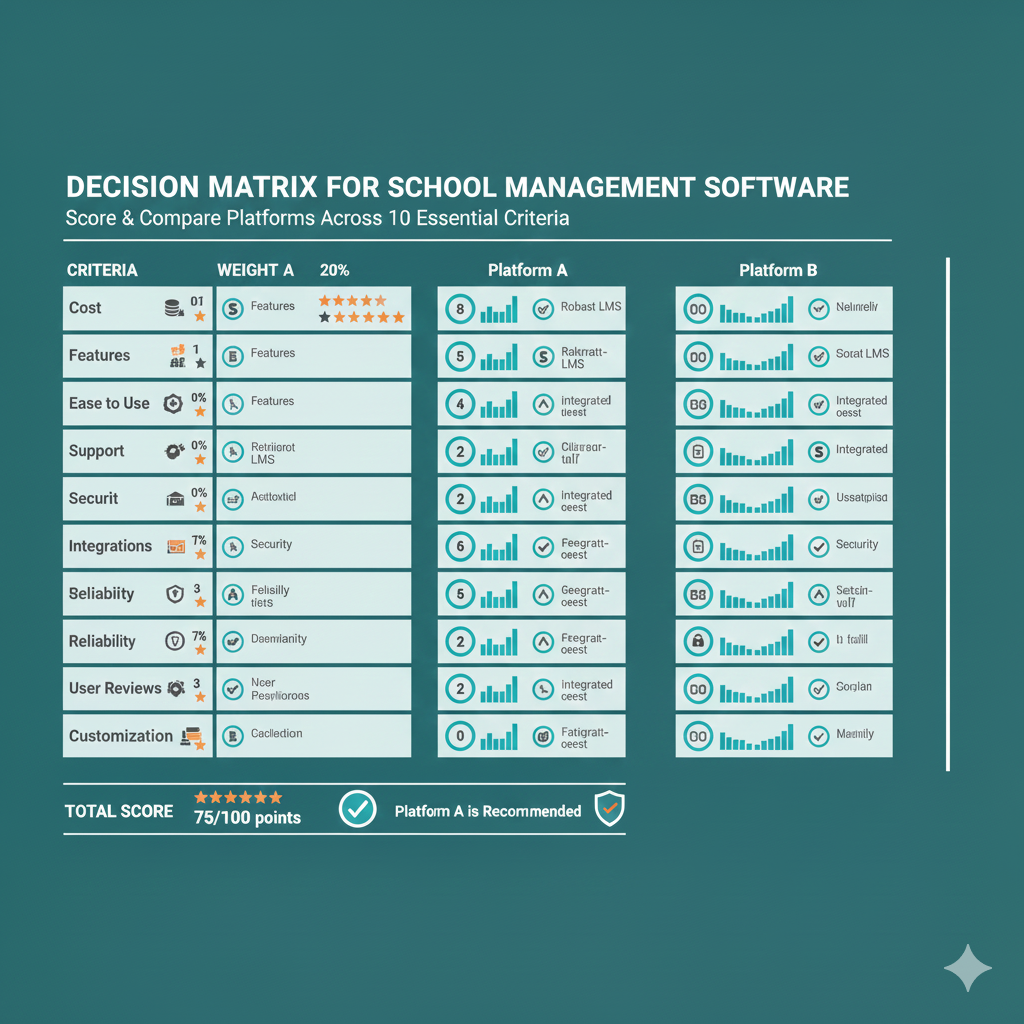
Create a Scoring Matrix:
List all essential criteria with weights based on your priorities. Score each platform against each criterion. Calculate weighted total scores for objective comparison.
Conduct Trial Periods:
Test top candidates with real users and actual school data. Gather feedback from teachers, administrators, and parents. Document strengths, weaknesses, and concerns.
Calculate Total Cost of Ownership:
Project costs over 3-5 years including subscription fees, training, support, and hidden costs. Compare against expected benefits and ROI timelines.
Check References:
Contact current users of top candidates. Ask about implementation experience, ongoing support quality, platform reliability, and overall satisfaction.
Trust Your Judgment:
Beyond objective criteria, consider intangible factors like cultural fit, vendor responsiveness, and long-term partnership potential. Your gut feeling matters after thorough analysis.
Key Takeaways
- Prioritize comprehensive academic management features including student information systems, automated grade calculation, timetable management, and assignment tracking that save time and improve accuracy
- Demand robust administrative tools especially digital attendance and fee management with Nigerian payment gateway integration, as improved fee collection alone often justifies platform investment
- Ensure excellent communication features including parent portals, mobile apps, automated notifications, and direct messaging that dramatically improve stakeholder engagement
- Verify Nigerian-specific localization including three-term calendar support, local payment integration, offline functionality, and responsive local support from teams understanding Nigerian education
- Calculate total cost of ownership over 3-5 years rather than focusing solely on initial subscription costs, and evaluate value through expected efficiency gains and improved fee collection
- Choose cloud-based solutions for most Nigerian schools due to lower infrastructure requirements, automatic maintenance, and better accessibility compared to on-premise systems
- Prioritize excellent user experience and intuitive interfaces, as even feature-rich platforms fail if users find them confusing or frustrating to use daily
Frequently Asked Questions
What are the most critical features to prioritize when selecting a school management platform?
The most critical features for Nigerian schools are digital attendance tracking that saves instructional time, comprehensive fee management with local payment gateway integration (Paystack, Flutterwave, Interswitch), parent communication tools including portals and mobile apps, grade management with automated calculations, and robust offline functionality for unreliable connectivity areas. Modern school management systems integrate these essential features seamlessly. Fee management alone often justifies the investment, as schools typically see 20-30% improvements in collection rates within the first year of implementation.
How can schools with limited budgets afford quality school management platforms?
Quality platforms deliver positive ROI within 12-18 months through improved fee collection, reduced administrative costs, and decreased paperwork expenses. Calculate total value including efficiency gains rather than viewing it purely as an expense. Many vendors offer flexible payment plans or scaled pricing for smaller schools. Start with core modules and expand as ROI materializes. Understanding software costs and hidden fees helps schools budget accurately. The question isn’t whether you can afford a platform—it’s whether you can afford to continue with inefficient manual processes that cost more in the long run.
Should Nigerian schools choose cloud-based or on-premise school management systems?
For most Nigerian schools, cloud-based platforms offer superior value. Cloud solutions require no expensive server infrastructure, provide automatic updates and maintenance, enable access from anywhere, scale easily as schools grow, and include vendor-managed security and backups. Only large institutions with robust IT departments and specific data sovereignty requirements should consider on-premise deployment. Cloud versus local platform analysis shows cloud platforms particularly suit Nigerian schools with limited IT resources. Cloud systems also better accommodate parent access from home and remote administrative work.
How long does it take to see return on investment from a school management platform?
Nigerian schools typically achieve positive ROI within 12-18 months, with many seeing benefits even faster. The largest financial return comes from improved fee collection rates, which often improve 20-30% as automated reminders and convenient online payment reduce late payments. Administrative time savings, reduced paperwork costs, decreased error correction, and lower staff overtime provide additional value. Implementing school management platforms effectively with proper training and change management accelerates ROI realization. Schools should track specific metrics including collection rates, administrative time spent on routine tasks, and parent satisfaction to quantify benefits.
Conclusion
Selecting the right school management platform in 2025 requires evaluating comprehensive academic management, robust administrative tools, excellent communication features, Nigerian-specific localization, user-friendly interfaces, security and data protection, integration capabilities, scalability, cost-effectiveness, and implementation support. Each criterion significantly impacts long-term satisfaction and return on investment.
Excel Mind excels across all these essential criteria, delivering a school management platform specifically designed for Nigerian schools. With comprehensive features, intuitive design, true local support, and proven results across hundreds of implementations, Excel Mind transforms school operations while improving educational outcomes.
Understanding school management trends in 2025 shows that digital transformation is no longer optional—it’s essential for competitive survival and operational excellence.
Ready to transform your school’s operations with a platform that checks every essential box? Visit Excel Mind today to schedule a free demonstration and see firsthand how our school management platform can revolutionize your institution. Join hundreds of Nigerian schools already experiencing improved efficiency, enhanced parent satisfaction, better fee collection, and more time for what truly matters—delivering quality education.